Friday, February 27, 2009

Re-Versing "Write what you know."

We've all heard "Write what you know."  I would reverse that and say, "Know what you write."

Many fine men and women have devoted their lives and careers to researching and publishing historical reference material. We owe them our respect, and, as writers of historical fiction, we owe it to ourselves, and our readers to make our stories as accurate as possible.  I do not think writers claiming to write historical fiction should ever scramble recorded history to suit a story.

Does this mean that we cannot adjust the facts to suit our plot? Well, yes -- and no. Most historical novelists have toyed with history for the sake of plot movement. However, the best of us do not do it without considerable thought.

One way to avoid problems with historical events and personages is to write 'between' the facts. Say, for instance, that information about the beginning and the outcome of an event is readily available, but your extensive research turns up nothing about the middle. Does that mean you can do whatever you want with the middle? Pretty much. Just don't kill off anyone known to have been around for the end.

Sometimes all you want is the flavor of an historical era. That is, in its way, harder to deal with than events. For example, how do people care for their clothes? How do they cook their food? How do they handle things like sanitation, disease, birth control, and a thousand other minute details of everyday life?  You won't need to put all of this information in your manuscript but you need to know it. You don't want to have a character using something before it was invented.

For FIXIN' THINGS, I needed to know if flat irons existed in the 19th century. My research of the 18th century proved their existence in that era. Therefore, it's a pretty good bet that my female lead will have one around in the 19th. Of course, setting a novel in 19th century America makes for easy research. So much information is available that knowing when to stop researching and start writing becomes difficult.

So, when is it time to do it? That, too, has a bifurcated answer.  NOW is a good time to start writing the novel, whenever now is, and NEVER is the perfect time to stop researching. I find myself doing additional spot research through multiple rewrites. And, everything I change must be checked for accuracy.

What if your story wants to happen in an unreported era? Then, it becomes essential to research previous times. My novel, SAPPHO SINGS, is set during Greece's dark period. While most of us are at least vaguely familiar with Athens and Sparta in the 4th Century B.C.E., and Homer showed us much of the 10th century B.C.E. but little or nothing has come down to us from the time between. What there was has been systematically destroyed by religious interests. Therefore, in order to make my story as accurate as conscience dictates, I studied what went before. Homer was a starting point.  To that I added the Bible, the Quaran and all the histories of Egypt and Mesopotamia I could get my hands on in those pre-Internet years.

I believe it behooves us, as writers of historical fiction, to spend the time and effort necessary to check and recheck any and all material we use from the past.

   -- or --

leave history strictly alone and write our fictions without the help of research and researchers. We cannot, in all fairness, slough it off. We cannot shrug and say, "It is such a small part of the novel, it doesn't matter." History matters, a lot, to your readers, or they wouldn't be reading your historical novel.

If you have good reason to believe that the situation you want to put a character in could not have happened in the time and place you wish it to, it is you and your character who must adjust--history cannot.

Saturday, February 14, 2009

I found a new toy

Ever wish you could find software that would help you organize your creative genius without laying out more than your last advance? Check out yWriter from Spacejock.

yWriter works on the scene level so it doesn't overwhelm by expecting too much of you too soon.

Best of all - IT'S FREE! See for yourself at http://www.spacejock.com/yWriter5.html

Monday, February 09, 2009

"I dunno. I disremembered."

As mentioned in a previous blog [see: When Characters Write Your Book 1/21/09], my fictional characters have a habit of writing much of my work for me. This morning I want to talk about such an incident.

Fifty years ago, while working on a short story for the writers' group I attended, one of my characters said something perfectly suited to the situation using a word I'd never heard before. When asked about an unpleasant episode from his past the boy said, "I dunno. I disremembered."

OK, I might have invented it but for me it was one of those perfect bits of language that dropped into my mind from the ether when only that single concept would convey what was needed. It would not have been enough for him to say he forgot. Forgetting happens to everyone and some things, as with what had happened to this boy are impossible to forget. This boy had managed to "disremember."

Guess I sold that story 'cause I just Googled and discovered that "disremembered" has found its way into a dictionary. However, it's presence in at least the Urban Dictionary does not surprise me since my little story was written in LA and we all know how information spreads from there. I remember inventing jokes while bartending in Hollywood and having them told to me as "new" in Arkansas twenty years later. I must have sold the boy's story and forgotten.

BUT! The dictionaries have it wrong when they say "disremember" and "disremembered" mean the same as "forget" and "forgot". Both "forget" and "forgot" are passive verbs meaning something lost at least temporarily. "Disremember" is an active verb that means "to forget": the deliberate act of putting something out of mind.

How many times have you tried to do that only to discover that the more you tried the more deeply rooted the memory became. And, the more it grew!

Sunday, February 08, 2009

Historical fiction or fantasy or all three.

This morning, while perusing Historical novel excerpts on Helium I came across an excerpt purported to be about my beloved hometown of Gettysburg. The author called it alternative history and of course I, being me, did not hesitate to let her know I thought alternative history belonged in the "fantasy" section.

Her approach to The Battle of Gettysburg is interesting despite the errors [eg. Chancellorville instead of Chancellorsville] being a bit off putting. I did however find the notion that Lee and Longstreet "planned" a battle @ Gettysburg more than a little disconcerting. Having grown up with the battlefield as my playground I learned early that Lee had no idea Lincoln would yank command of the Army of the Potomac away from McCellan nor that Meade would immediately bring the army north.

I love historical novels and I have a particular fondness for novels centered upon Gettysburg [as witnessed by my own novel FIXIN' THINGS] but I believe that novelists have a duty to their readers to either keep available facts straight or label their novels fantasy not historical. But then again, that's just my never humble opinion.

                                                FTCOVERSCAN

Saturday, February 07, 2009

Wonderful World

Despite whatever troubles you today we all need to be reminded once in a while what a gift this world of ours really is.

It's all in the message, Babe.

This morning, inspired by my friend Marvin Wilson over at Tie Dyed Tirades I bring you a fabulous young never to be Beat poet named " target="_blank">' target=_blank>Alix Olson. Enjoy!

Friday, February 06, 2009

PRETZEL PLOTTING

There are as many ways to plot a story as there are stories.  But, as we all know, some are better than others.  This leads me to what I call Pretzel Plotting (putting the cart before the horse and making the horse like it) 

In a basic Confessions type story, the expected plot is sin, suffer and repent.  But, it makes a much better story if the suffering comes after, rather than before repentance, as in sin, repent, and then suffer anyway.

For example: The protagonist does something deplorable and gets away with it.  Later, plagued by a guilty conscience, she attempts to make things right.  However, in the process of making things right, suppose she tells a series of lies that make her appear guilty of a crime.  Now we have a woman, repentant for her intolerable act, innocent of the crime of which she is accused, but helpless to defend herself without telling the truth about the despicable thing she did.  Sound like a soap opera?  It is.  But, it is also an intriguing plot with lots of possibilities.

Pretzel Plotting is taking the standard plots and turning them on their ear much as many current Historical Romance writers are doing.  I have recently read over a three dozen such novels for research.  In each of them, her own actions catch the protagonist, and she and her antagonist end up married early in the book.  By the end of the novel, they are madly in love.  A Pretzel Plot based on the boy meets girl/boy gets girl dichotomy but twisted into a more interesting shape.  A good example of this is in The Thorn Birds, both protagonists have long since repented for their earlier involvement.  Nevertheless, in the sequel, everyone is suffering from it.

"What if" is the stuff of which Pretzel Plots are made?  What if Hitler had not died?  What if Eisenhower had not halted his forward thrust to let the Russians enter Berlin first?  What if Custer had followed orders?  What if Pickett hadn't?  What if Scarlet had been named Gertrude Hoffhausen?  Or, Sherman had taken a different route?  What if Tiny Tim had won the lottery?  What if Rocky had fixed the fight?  What if Luke's father had never gone over to the Dark Side?

     Pretzel Plots.  Find your story.  Get fully acquainted with your characters.  Put them in a situation.  Then, turn the situation inside out.  Wrap it in and over itself.  Put your characters through the wringer, but make them tumble-dry themselves.

                                                                           AWAKEN

Thursday, February 05, 2009

I NEED A WIFE


[Originally written while my husband lived but still relevant]

Have you ever wondered why male authors appear to be more prolific than women?  Historically, they do have more published books.  But, I don't believe that men are the better writers simply because they have more books on the market.  I believe they have more books on the market because most of them have/had some woman to sweep their floors, wash their socks and make sure they took time out to eat.  Some men even have the kind of wife who does everything for them except their thinking.  You know.  They're the wives you read about.  The ones who type one-hundred-and-twenty words a minute.  Now, I want one of those.

A wife who cooks and cleans and types and gives good back rubs should be standard equipment for all potential authors.  I need a wife to do all of the stuff my dear husband, who is retired and home all the time, thinks I should do immediately, if not sooner - just because I'm here.  It doesn't matter that I'm deep into structuring my third novel.  The tomatoes are ripe and have to be scalded and peeled - NOW!  "Sure, dear, find me a wife and she'll do it while I figure out this new character's astrological makeup."

Yesterday, I planned to work on the rewrite of my second novel - but yesterday there were peppers to be pickled.  Right now, our kitchen table has more ripe tomatoes on it than my desk has disks - and BOTH need processing.  Oh, boy, do I need a wife.  My house hasn't had a wife since the last kid left home and I retired.  Well, not really.  My husband retired.  I couldn't retire as a housewife because I never married a house in the first place.  I married a man who cooked, and I raised my kids to either clean it or ignore it.

I did both while they were still around.  And, I wrote umpteen drafts of two novels, on a Remington Standard, in the midst of it.  But, since they grew up and left and I've discovered the joys of virtual cut and paste, I've been writing full time and it is beginning to pay off, in spite of wifely interruptions.The earlier [truncated] version of my work on Sappho entitled PSAPPHA was produced from the draft I wrote in 1969, with five kids under twelve fighting in the background, and released in November 2000.  Now out-of-print you can read the restored, revised, augmented version as SAPPHO SINGS.

My Gettysburg novel, FIXIN' THINGS took 30 years from draft to print, It might have come out years earlier - if I'd only had a wife.

Tuesday, February 03, 2009

A poem that sings to me.


I found this recently and needed to share it.

30 January 2009
From Muse to Id
That dark lady I call my muse,
Angel of art inside my head.
My tears are shed as she sings blues,
That dark lady I call my muse.
Colours scheming in vibrant hues,
each time I lay there in my bed.
That dark lady I call my muse,
Angel of art inside my head.
Ideas float with static clues,
That dark lady I call my muse,
She brings them forth in words to use
In pictures tonal views are read.
That dark lady I call my muse,
Angel of art inside my head.

She holds me tight in vice-like grip,
yet tender is her sultry touch.
In thought, imagination’s trip
She holds me tight in vice like grip,
from her chalice I gently sip,
at first it all seems double Dutch
She holds me tight in vice-like grip,
yet tender is her sultry touch.
As words and art  meet my pen tip
She holds me tight in vice-like grip,
she guides the words that form on lip,
the ink on paper now my crutch
She holds me tight in vice-like grip,
yet tender is her sultry touch.

That dark lady I call my muse,
She holds me tight in vice-like grip,
Eases the way that I confuse,
That dark lady I call my muse.
Images once lost, now diffuse
and on paper they swiftly slip
That dark lady I call my muse,
She holds me tight in vice-like grip,
no longer words can I excuse,
That dark lady I call my muse,
As I dwell in fantasies views
I see I’m now her fingertip,
The dark lady I called my muse,
I hold me tight in vice-like grip.

© Jem Farmer 2008, all rights reserved.

Thursday, January 22, 2009

WHEN CHARACTERS WRITE YOUR BOOK

Sometimes a character you intended as a walk-on will walk away with your heart.  That was what happened to me when writing SAPPHO SINGS.  I introduced Gongyla so well she would have taken over the book had I let her.  But the book wasn't about Gongyla.  The book is about Psappha, as the divine Sappho called herself.  Psappha was a real woman, a famous poet, an inventor of language and meter, quoted by Masters of Greek Grammar and Literature centuries after her death for her perfection of style and form.  It was my joy to put her words back into her thoughts and dialog.  She was the focus of my Muse for more than forty years.

Nevertheless, Gongyla refused to leave my imagination and in doing so she stole Psappha's heart as well.  The name was taken from an almost complete poem of Sappho's.  A lovely piece that survived through the ages to grace our modern world.

But, like many times during the book's creation, I didn't start out to talk about Gongyla today.  I wanted to talk about characterization tools.  My favorite and most useful is to discover pictures of my characters in magazines (usually by accident) then frame them so that they look down from my office walls as I write.  First,  the irrepressible Gongyla as portrayed for me by Roanne Nesbit

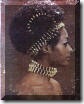
Gongyla_smallAnd the lovely unknown who served as model for Psappha

Psappha

(page clipped from New Woman magazine's February 1972) 

Monday, January 19, 2009

To Librarians With Love

Previously, I wrote about the ethics of attempting to write historical fiction using shoddy research and I could almost hear some of you saying, "That's easy for her to say. She probably lives within walking distance of some huge library."  Right?  Wrong.
The bulk of my research was done when I lived 9 miles from the nearest town and 11 miles from the nearest library, when Bill Gates was still in diapers. And I have never had a driver's license.
What I did have was an enthusiastic librarian who taught me about the wonders of Inter-Library Loan. Through ILL, one can get just about any book from nearly anywhere, and sometimes half the fun is seeing where the books come from. I once borrowed a book on Feminist Witchcraft from a library in Yazoo, Mississippi.  Who'd a thunk it?
To use ILL effectively, you must first familiarize yourself with some reference tools. Specifically, a series of volumes titled BOOKS IN PRINT. Admittedly, to find what you need you often have to search the library's storage area for out of print volumes of Books in Print. Take a feather duster with you and do the librarian a favor while you're there. Sometimes, you may have to dig through several decades of dust to find exactly the title you need. However, I believe that, no matter what you want to find out, someone has put it in a book at some time or other. If not, it's time to write your own.
That's where my enthusiastic librarian came in. Although I could get to the library only on weekends when my husband came home from work, she searched the archives all week, and sent queries along with books she was returning. She requested books she thought I might be interested in without my asking and, every time I got to talk with her, she had a list of possible sources ready for me.
Another surprising thing is that I was sometimes able to study precious reference tomes that had to be read in the library because they were not available for public loan. This is an often-overlooked advantage to ILL. Once, when she obtained an extremely old and fragile volume on a limited loan, she personally hand-copied many pages for me because I was unable to stay at the library long enough to do it myself.
Remember, these were the times before copy machines reached small town America. Naturally, not every librarian would have the time to do all of that, no matter how enthusiastic they might be about a project. However, most of those I have worked with have been extremely supportive and generous with their time.
Librarians, with or without a Library Science degree, are an invaluable asset to the serious researcher. In fact, I have found that the smaller the library, the larger the heart of the librarian and the greater their enthusiasm for the written word.

Blessed be librarians one and all.

Wednesday, January 14, 2009

So tired my tired's tired

Ever move on almost no notice?  Rough, isn't it?  My daughter got 10 days notice to report to her new job in another state.  Talk about rush!  Sweetlings, if you've never done it you just don't know.

My youngest called last night and asked if I had all the boxes unpacked.  Jeesh! Can you imagine the gall?  I arrived here Saturday after a marathon of packing, shuffling, loading and unloading and he wants to know if everything's unpacked by Tuesday night.  Wow!  And HE complains about HIS back.  Get real, pup, the old beotch may be great but supermom she ain't.

He knows how much got left behind [it was "old"] We had to spend Sunday shopping for beds and all that goes with them. Plus other stuff.  We're grrls ya know. Then there's cable, computers and phones to set up, email to catch up on, friends to call and update. All unpacked indeed!

You never know how much financial minitue you deal with every day until you have to transfer everything.  How did we ever manage before the web and 800 #s?  That stuff alone took me from 5 to 9 this morning. Unpacking can wait. Shoot fire, pup, my bed won't be delivered 'til tomorrow and a camp cot's danged narrow.  Would be poor sleeping even if I wasn't sharing it with a fat calico cat.

I should get off this computer now - oops, it's almost noon. The boxes can wait. My soaps start in 5 minutes.

Thursday, December 11, 2008

When your Muse won't cooperate

What do you do with a head full of ideas that don't want to be put on paper?  It's not the Dreaded Writer's Block.  The ideas are there but they develop a stubborn streak somewhere between your fingers and the keyboard.  If this happens to you, try something else.

Remember long hand?  Do the words and phrases come off your fingertips better when kicked back in your favorite chair with a pen or pencil in hand?

How about dictation?  Updated Voice Recognition software lets  you lean back, shut your eyes and tell your stories as they display themselves on the inside of your eyelids.

Or, maybe your Muse wants to get out of the house.  Try taking a recorder on a stroll through your neighbor or a local park.  Used to be when I did this people looked at me askance but these days they just figure I'm talking on a cell and move on.

Whatever works.  That's the key.  Once the words begin to flow you can let your characters takeover at least for the rough draft.  There'll be ample time to tame them later.  The important thing is to create something substantial enough to edit.  Write on!

Friday, September 12, 2008

How to begin

You try and try to get started on a new novel but nothing gets written until the characters are darned good and ready.  They'll let you know when that is so you might as well relax.  It ain't gonna happen 'til it happens no matter how hard you push your Muse.

Best Historical Fiction I've read in a long time.

The Phoenix by Ruth Sims (Writers Collective, 2004) 343 pages ISBN: 1932133402

This is one story you don’t want to miss. It had me crying before I got past chapter two and laughing halfway through chapter eight. The book is a marvel of passionate difficulties without ever feeling like an emotional roller-coaster.

There were a few point of view problems with description of what the POV character did not see but they were not severe enough to interrupt the flow. Altogether, the writing is superb, evocative. I found some details a bit jarring, not because they were out of place, but because I was surprised to discover that such things existed so long ago.

The author’s research is flawless, her writing tight and uncluttered. This is not a book for skip readers. Every word and comma is essential to the story, which, to this reviewer is exactly as it should be.

The love between St. Denys and Dr. Stuart is subtle, sultry and real; their emotion deep, rugged and lasting. I paused many time to sit back and let the intricacies of the story flow quietly through my mind.

One could not help but laugh at the thought of The Mrs. Aster with diamonds on her knickers.

The Phoenix thoroughly involves the reader. The specifics of both theater and surgery pull the reader into diverse scenes with ease, and hold them there – in the past – with Kit when his worthless excuse for a father comes after him. Tom Roarke is an excellently drawn villain. This reader could not wait to see him meet his end.

By chapter twenty-two, the urge to steal a glimpse at the end is strong and difficult to resist but you must resist it or you’ll miss the fun. As with any good drama, just as near unbearable the move toward the finale begins complete with comedy, unexpected misunderstandings and false hints.

Overall, I can’t remember when I’ve ever enjoyed a book so much. Get it. Read it then pass it along. This one is definitely worth sharing [if you can bring yourself to part with it at all]


Peggy Ullman Bell: author Fixin’ Things & Sappho sings. http://peggyullmanbell.com

Wednesday, June 04, 2008

And the beat goes on - and on

Over 40 years ago, when I first became enamored with Psappha her true name was little known outside of academia. This is, unfortunately still true today. Rather than being honored for her creative genius her outstanding reputation is in shreds of Freudian angst.

Although I decry the need, I can well understand the current lawsuit filed by the people of Lesbos to halt the using of their citizen’s national designation in the titles of homophile organizations. Even here, Lesbos shows as a spelling error while the names of such places as Chernobyl , Uzbekistan and Zimbabwe even though Lesbos is ancient by comparison.

Yesterday, I was told that mention of SAPPHO SINGS, my fictionalized biography of The Poetess of Lesbos was inappropriate on “family oriented" email list for writers [mostly professional like myself]. "There are children as young as 11 here," I was told. How easily history is distorted by the uneducated in the name of protecting the children. What are they protecting them from? Poetic genius? Truth? Anything that goes contrary to the anal retentive Freudian Patriarchal perspective? It would seem so.

I'm here to tell you that my curiosity has not altered much throughout my life. Sappho, of Psappha as she called herself would have been every bit as fascinating to me at 11 as she was at 36 IF I had been allowed to hear of her which of course I wasn't.

I find it sad that so little has changed between my adolescence and now. Generations of ignorance and intolerance continue unabated. The great scholars of Greece lauded Sappho as they lauded Homer. Plato called her The Tenth Muse. Solon of Athens refused to die before hearing her latest work yet American men and women cringe from mention of her very name having never read a single word she wrote. I can't help but wonder just what it is they are so afraid of.

Incidentally, as I typed, not a single man's name was flagged as a spelling error no matter how long ago he lived. Yet, the lovely Sappho/Psappha is tagged - every time. I wonder why that is?

Sunday, May 25, 2008

Author's Note

SAPPHO SINGS SAPPHO SINGS by Peggy Ullman Bell


My review


rating: 5 of 5 stars
SAPPHO SINGS is a substantially augmented and enhanced version of my fictionalized biography of The Poetess of Lesbos, previously published in part as PSAPPHA, a novel of Sappho


Although long dead, Psappha, as Sappho called herself in her own soft Aeolian dialect is and has been the love of my life for over 40 years. In my heart and mind she lives, loves and laughs.


Writing her story has been my profound joy.


View all my reviews.

Sunday, April 20, 2008

Yahoo Answers

Tuesday, April 15, 2008

New

The Poetess of Lesbos

SAPPHO SINGS

(to be released summer of  '08)

       sans apology, sans censure.

In this superb page-turner reminiscent of the great Mary Renault, Peggy Ullman Bell brings to life one of the most exciting and fascinating figures of the Ancient World - Sappho, "The Poetess."  A woman who surpassed the conventions of her time.

Introduction

Excerpted from The Life of Greece by Will Durant

  (Simon & Schuster, N.Y., 1939)

“Sappho was a marvelous woman," said Strabo...

"Psappha, as she called herself in her soft Aeolian dialect, was born at Eresus, on Lesbos, ...Pittacus, fearing her maturing pen, banished her...

"After five years of exile she returned to Lesbos and became a leader of the island's society and intellect ... Eager for an active life, she opened a school for young women, to whom she taught poetry, music, and dancing; it was the first 'finishing school' in history....

"Her verse was collected into nine books, of some twelve-hundred lines, six-hundred survive, seldom continuous."

A new Sappho poem
Martin West
21 June 2005

From these fragmented lines, Ms. Bell has created a novel rich in the textures of ancient Greece, yet modern as tomorrow's fashions.
Bell has incorporated the fragmentary words and phrases still available into the novel in a way that makes them vanish into the fabric of the story like golden threads woven into an intricate tapestry so delicately that it becomes impossible to distinguish the imported threads from the weaver's own.
Readers familiar with the myriad of translations may recognize a word here or a phrase there but, as one expert in antiquities discovered, the author has herself become the voice of The Poetess to the extent that invented passages seem like newly discovered wonders from the past.

Wednesday, April 09, 2008

It's a book!

SAPPHO SINGS, my fictionalized biography of The Poetess of Lesbos, is in its final stage of editing and should be ready for presentation to the publisher within the month.

SAPPHO SINGS is based upon and built around the existing fragments of Sappho's work.

Custom Search